(23.11.2026)
The moth and the mountain.
I arrive at the trailhead just before 8am. Three large Eastern Grey Kangaroos chew the damp grass as I pack the last few items into my bag.
I begin walking down the track following Mountain Creek for a few kilometres before stopping to fill out the trip intentions book at the bottom of ‘Staircase Spur’. A fitting name for the track to the summit of Mt. Bogong, mainland Australia’s second highest peak. It’s still, almost silent and I can feel the blood pumping through my body as I ascend the steep track. It only takes a kilometre of climbing to regret packing the two cameras, tripod, film and batteries I needed to make photographs on the mountain. The walking is slow and monotonous and the track is enclosed by tree cover, making it hard to know how much elevation I’ve gained. After a few hours I break through into a clearing next to Bivouac Hut. I sit in the clearing looking at the names scrawled across the faded weatherboards of the hut. Spencer + Jake 2026, Rose 2022, Dave and Chopper Feb 94, Tony was here 1990. I think about the history of place and all the footsteps that have walked on this landscape.
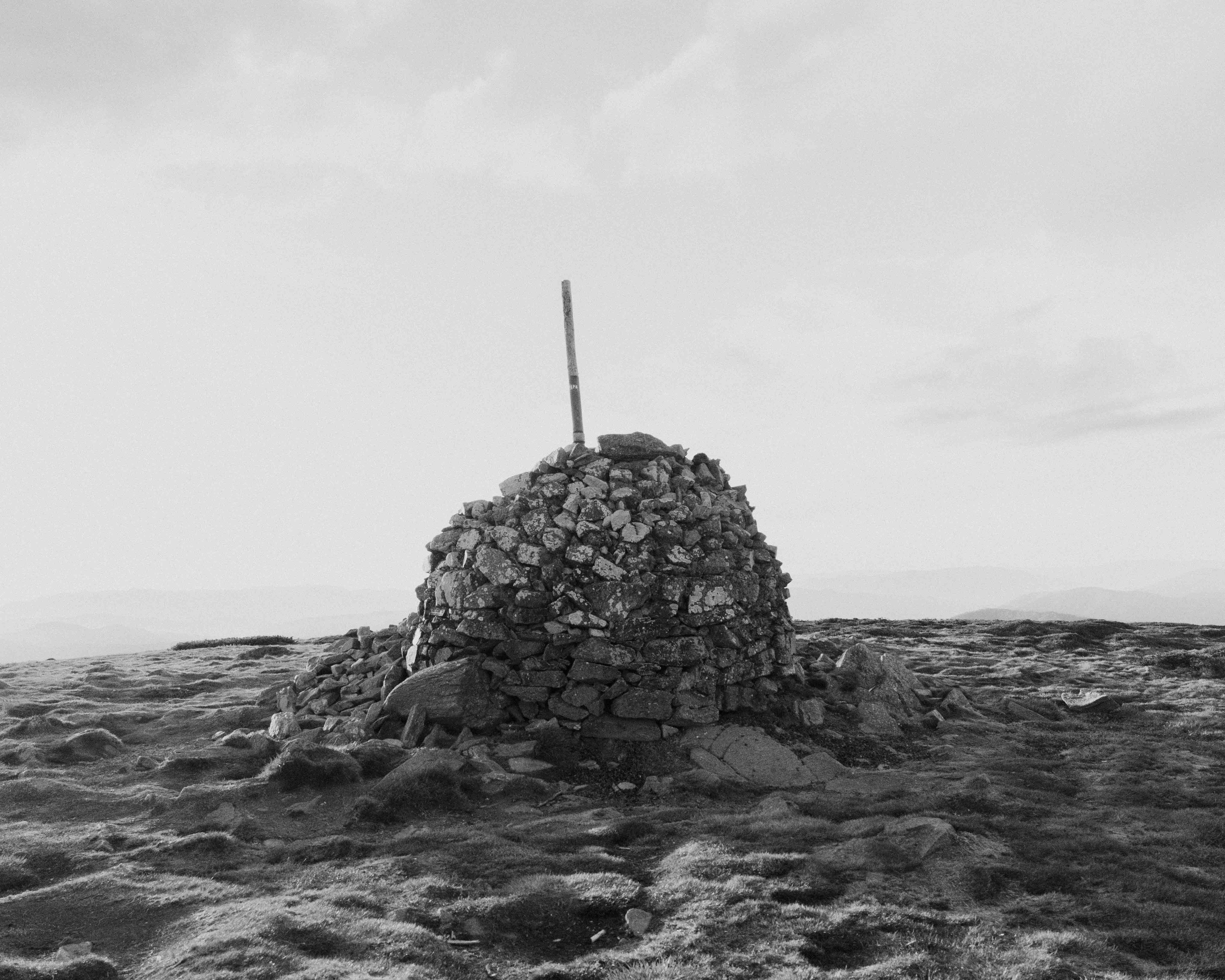
I continue up the track, as I pass 1700m I come through the treeline and get 360 degree views of the range. Steep granite outcrops fall away to my right and the scale of the mountain becomes apparent. I see the marker posts zig zagging up the rock in front of me. I scramble up the rock, between abundant bushes of alpine flowers. I’ve been hiking for about three and a half hours now and I can finally see the summit. I approach the top, the summit is a vast grassy area that gradually descends away towards steep granite outcrops. There is a large cairn with a steel pole erected lopsidedly out of it, marking an elevation of 1,986 m. My sore legs approach it ready to lay in the grass next to it. I look down to see hundreds of Bogong Moths scattered in the grass, wind gusts rolling them over each other. Most of the moths I can see are dead but occasionally a live moth appears from under the debris and lethargically crawls its way towards the cairn. I wonder if wind has blown them out of their hiding, or if heat has caused them to perish. There are so many factors that it’s hard to know what has caused an apparent mass death. I watch the piles for a while and make photographs.
In the afternoon I descend down Eskdale Spur towards Michell Hut, where I pitch my tent, rest my legs and eat my dinner at 4pm. As the sun begins to make its way towards the horizon I pack my bag with only the essentials and make my way back towards the summit. The 3km is steep but it feels manageable with less weight on my back. On the way back up I peek into granite crevices looking for moths but don’t find any. At the cairn in the setting sun more moths move and I can hear the fluttering of wings within the rock structure. I make pictures and wait, hoping these moths will take flight and fill the sky as it goes from blue to black. There is no sudden burst of movement though, the sky stays empty and cold tonight. I descend back down to camp under light from my headtorch, as it illuminates clouds of my breath.
In the morning I pack up camp and begin the descent back through the treeline. By 9am there is already heat in the day and I wait to see a snake on the track in front of me but never do. I get back to my car pleased with the accomplishment of climbing the mountain and feeling fortunate to have witnessed so many moths. Being in the landscape has given me so much insight into their environment, their challenges and their behaviour. I’m excited to continue making works for the project and learning more about the moth.
I spend the rest of the week walking down firetrails, soaking my legs in the river, editing images and writing paragraphs. My time in Bogong has been really valuable. For me there is always a jumping off point for a project, a time when it transitions from an idea into a real thing. Being able to spend an extended period of time in this landscape has allowed this idea to become a real thing.